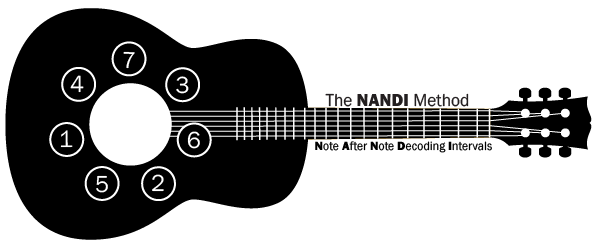
Hello and welcome to The NANDI Method!
Frequently Asked Questions
Why was this method created?
While there are ear-training methods to recognize intervals by sound, methods that teach you to visualize intervals on the guitar are extremely limited. Most guitar courses give little attention to this subject even though intervals are the building blocks of scales, chords, and chord voicings. A system that fully addresses this missing visual link on the fretboard has long been needed.
What is the main concept behind it?
The purpose of this approach is to train players to see the guitar in interval numbers instead of just note names. Whether locating an interval on adjacent or non-adjacent strings, or improvising freely across the fretboard, the ability to visualize intervals is essential to understanding how music connects on the instrument.
How does the NANDI Method address this?
To solve this long-standing problem, the NANDI Method—short for Note After Note Decoding Intervals—was created as a logical system that replaces memorization with visual reasoning. It teaches guitarists of any level to map, decode, and connect interval relationships naturally across the fretboard.
What do students learn through this method?
Students learn to name, locate, identify, analyze, derive, and invert intervals using logic instead of memorized shapes. By correlating the open-string relationships with the spatial layout of notes, the fretboard becomes an organized interval grid rather than a confusing collection of positions.
How is it practiced and applied?
Practice starts on a dry-erase reusable blank 12-fret sheet, where students plot and connect interval patterns before applying them on the guitar. This written-visual practice builds clarity, strengthens recognition, and deepens fretboard understanding.
What does this method teach?
This is not a traditional “how to play guitar” method—it’s a visual learning system that introduces new strategies for decoding the guitar’s interval matrix using detailed fretboard diagrams. It reveals how to identify and locate intervals logically by uncovering the layered structure of interval and inversion patterns that exist across the neck. The goal is to train students to visualize every interval on every string set without relying on memorization.
What is the foundation for this method?
The foundation of this method lies in proving that you can master the interval fretboard without memorizing chord or scale shapes. It begins by examining the relationships between the open strings and how those relationships repeat in predictable ways across the fretboard.
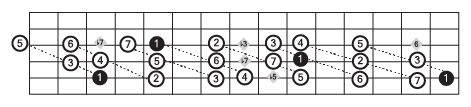
Because the guitar is tuned mostly in perfect fourths, this interval pattern dominates the instrument’s structure. It runs almost horizontally across six strings and two frets from the lowest string to the highest, creating a consistent framework for locating notes and intervals.
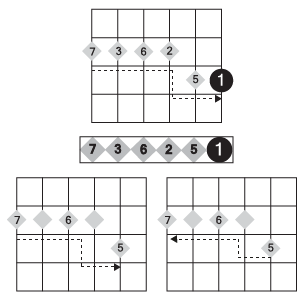
Since fourths occur on the same fret between adjacent strings (except between G and B), they become the most reliable reference point for navigation. Once these fourths are understood, other key interval patterns—seconds, fifths, and sevenths—emerge naturally, revealing the internal logic of the fretboard.
How is this method implemented?
Most traditional resources only cover intervals in a single direction—counting half-steps up or down one string to form chromatic or scale intervals. This approach goes much further.
By recognizing and mapping the fourth, fifth, second, and seventh patterns across all string sets, players learn to plot intervals and their inversions anywhere on the neck.
This visual and analytical process exposes connections that often go unnoticed, turning the fretboard into a clear network of relationships rather than random note positions. As these strategies are applied, students gain instant reference points for identifying intervals and inversions, dramatically accelerating fretboard understanding.
What is the logic behind this method?
Many players view the guitar as an impenetrable grid of notes—but that illusion disappears once its natural interval structure is analyzed. The fretboard isn’t random; it’s a cohesive arrangement of four recurring interval patterns.
Although chords are commonly built by stacking thirds, on guitar, the fourth interval is far more visually and spatially consistent. Using fourths as a primary reference makes it easier to find the higher note of any interval.
Because fifths are inversions of fourths, the reverse applies when locating notes on lower strings.
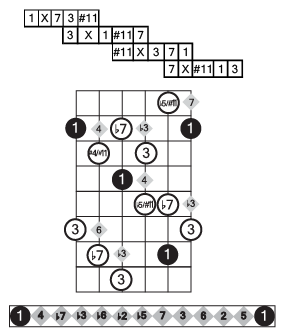
Additionally, the open-string relationships can be used as fixed guides to navigate around CAGED root areas:
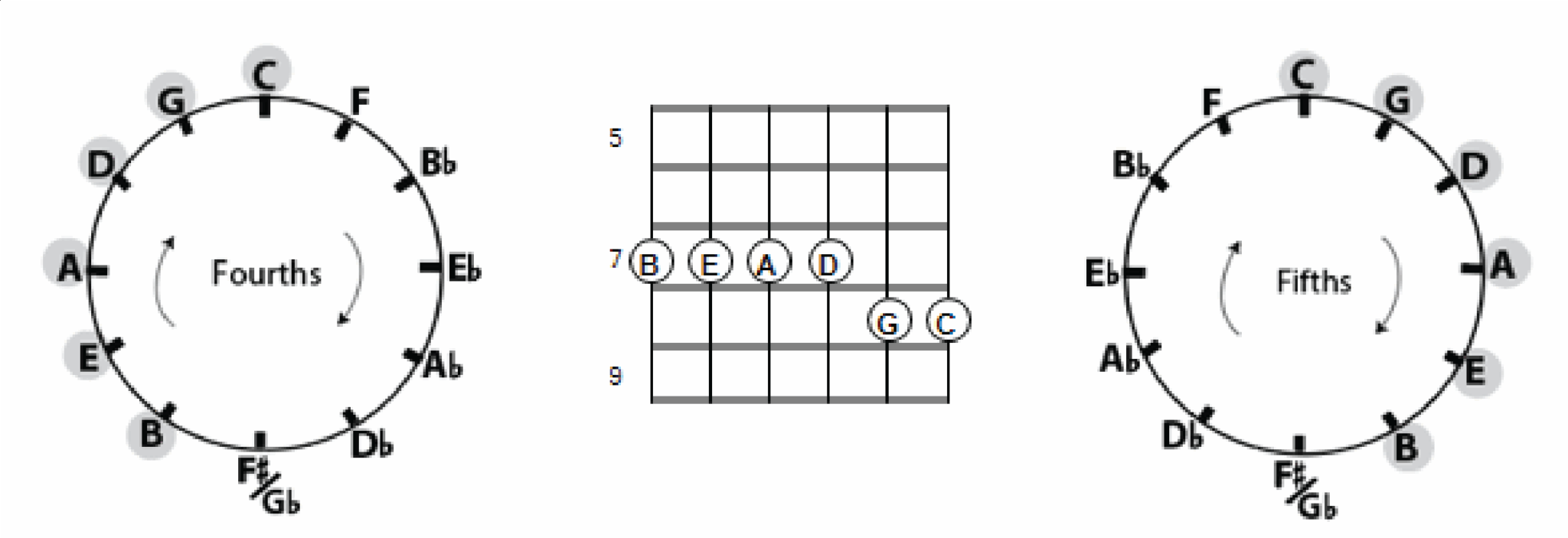
A–B (C shape), A–G (A shape), E–G (G shape), E–D (E shape), D–B (D shape)
This logic allows any interval to be located quickly, anywhere, using reference patterns that already exist within the tuning of the instrument.
Who can benefit from this approach?
This system is designed for all guitarists—from beginners who want to build a solid theoretical foundation to advanced players seeking to break free from memorized shapes.
Even experienced musicians who know their chords and scales will discover new clarity by learning to see intervals as numbers and spatial relationships, not isolated shapes. Once applied, this method opens the door to complete fretboard fluency and creative freedom.
Beginner / Advanced Beginner:
What will beginners learn through this method?
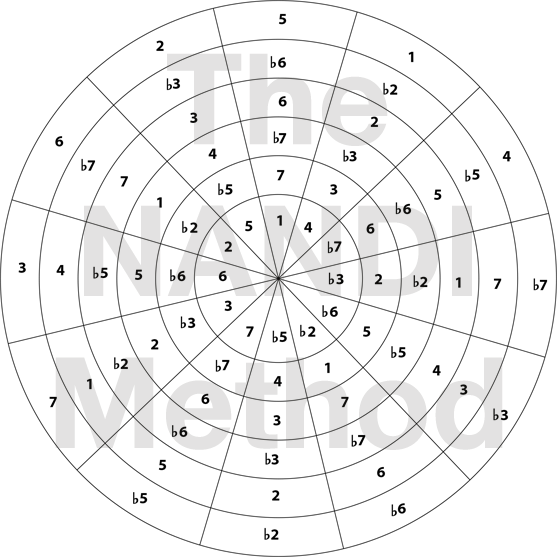
Beginners are introduced to music theory from a fresh, practical perspective that connects directly to the guitar fretboard. Students learn to recall note names and interval numbers horizontally across strings by applying the Circle of Fourths and Fifths, understand interval naming conventions using natural notes from the C major scale, and use mnemonic devices to memorize both letter names and the twelve interval numbers. They practice locating and naming natural notes across frets rather than moving vertically along one string, making navigation simpler and faster. Students also learn to transition easily between natural and accidental notes across strings, derive sharps and flats in any key without referencing the major scale itself, and alter interval qualities by adding a sharp or flat. In addition, they identify intervals that involve accidentals without counting half- and whole-steps, assign the correct enharmonic spelling to notes within an octave, and use straightforward algorithms or the existing relationship between two strings to determine an interval’s precise fret location. All of these shortcuts are designed to teach foundational theory in a clear, logical, and time-efficient way—helping beginners master concepts much faster than through traditional memorization-based instruction.
Why is this method easier for beginners?
The approach removes unnecessary barriers such as complex notation. Instead of requiring students to read staff lines, the system presents all information visually on the fretboard. Each concept is illustrated through clear, labeled diagrams that show both notes and interval numbers. Because the brain processes visuals more efficiently than text, this method allows students to recognize and retain relationships faster. The merits of visual learning are undeniable—it enables beginners to grasp structure, pattern, and spatial awareness in a fraction of the time normally required.
How comprehensive is the training?
Every possible interval between any two letter notes—or interval numbers—on every string set is analyzed and demonstrated. Learners study how to alter intervals logically using natural notes and natural numbers through direct, easy-to-follow explanations. The material is presented in a methodical sequence, allowing steady progress at each student’s individual pace and level of understanding.
Intermediate Student:
How does this method benefit intermediate players?
The foundational concepts described earlier serve as valuable supplemental material for intermediate guitarists. Expanding knowledge through multiple approaches always strengthens understanding. By applying the tips, tricks, and shortcuts taught in this method, players at this level gain new ways to navigate the fretboard logically and efficiently.
What changes for the intermediate student?
At this stage, most guitarists locate intervals by referencing known letter-note positions. This method introduces a more practical approach—using naturally occurring fourths and the interval relationships between string pairs as reference points to determine note or interval placement.
How are intervals located mathematically?
Students learn to use the pitch distance between open strings on any string pair to locate interval numbers and note names accurately. The concept of “Interval Architecture” is introduced, showing how to derive the exact fret location of any interval using simple, repeatable formulas.
Can this method help with memorizing all notes?
Yes. Players can systematically determine the fret position of any note by treating the open string as the root and calculating the target note’s distance in half steps. Because each half step equals one fret, this logical approach allows students to confirm note locations on every string using clear, organized tables—eliminating guesswork and improving precision.
Advanced Student:
How does this method support advanced players?
Seeing the fretboard as a connected network of interval numbers is a challenge shared by beginners and experts alike. Without a strong foundation in visual interval training, many players rely solely on memorized chord shapes. This method helps advanced guitarists strengthen that missing visual link and connect theory directly to the fretboard.
Why is visualization essential at an advanced level?
Beyond technical skill and ear training, advanced players must also be able to visualize intervals while playing chords, scales, modes, and arpeggios. Understanding these visual relationships allows for greater control, fluidity, and creativity when performing or composing.
How does an advanced player benefit from this approach?
After years of rote learning, shifting perspective can feel unfamiliar, but the results come quickly. Even experienced players soon recognize how this logical, verifiable method clarifies the fretboard. For teachers, it becomes a valuable framework that helps students avoid memorization fatigue while learning faster and more efficiently.
What specific skills are developed?
By applying these concepts, advanced players learn to locate intervals on non-adjacent strings, recall fret distances between roots and intervals in either direction, and visualize intervals within chord voicings while playing progressions. They can also identify chord tones, extensions, and alterations in complex jazz voicings, use interval inversions while improvising, and navigate the fretboard seamlessly during solos.