The Interval Pattern Of Fourths: The NANDI Method
Check out The NANDI Method on YouTube! Below is our companion video to this lesson!
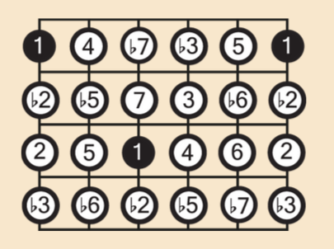
It’s easy to visualize the twelve scale degrees as you move from the root to the octave using half-steps. For example, all twelve degrees in the C chromatic scale can be played on one string—the B string—moving fret by fret from the first fret up an octave to the 12th fret.

Pretty simple, right?
Simple enough, right? But when you try to see those same twelve degrees across all six strings, things quickly become confusing.
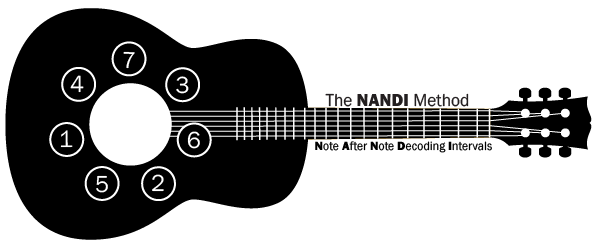
That’s where the NANDI (Note After Note Decoding Intervals) system comes in. It helps guitarists decode the fretboard by revealing how notes and intervals are related through logic rather than memorization.
Why Fourths Matter
When you study the guitar, you discover that the interval of a perfect fourth defines most of the instrument’s structure. If we reorder the twelve interval numbers in a scale according to fourths, the sequence becomes:
1, 4, ♭7, ♭3, ♭6, ♭2, ♭5, 7, 3, 6, 2, 5, 1

To make it easier to understand, the sequence can be divided into two related groups. The pattern 7-3-6-2-5 appears twice – once with flats (♭7-♭3-♭6-♭2-♭5) and once with natural intervals (7-3-6-2-5). The flat pattern is preceded by 1 and 4, while the natural pattern is followed by 1 and 4.

Finding Fourths from the Root
If we look at this in the key of C, the natural notes in the fourth pattern form a clear visual path. If we only want to see only the natural notes in the fourth pattern, the sequence looks like this:

Most players begin on the root, so to find the fourth, simply count five chromatic intervals from the root: ♭2, 2, ♭3, 3, 4 (1 to 4).
Another quick way is to think of it in whole-step movements between pairs of fourths.
-
From 1–4, move a whole step down → ♭7–♭3
-
From ♭7–♭3, move a whole step down → ♭6–♭2
-
From ♭6–♭2, move a whole step down → ♭5–7
-
From 7–3, move a whole step down → 6–2
-
From 6–2, move a whole step down → 5–1
Applying The Pattern To The Fretboard
To apply the sequence visually, use the mnemonic:
One Forsaken Tree Set To Fire → 1-4-7-3-6-2-5
This helps you move across the fretboard in fourths. Remember: when crossing to the second (B) string, shift up one fret to maintain the pattern.

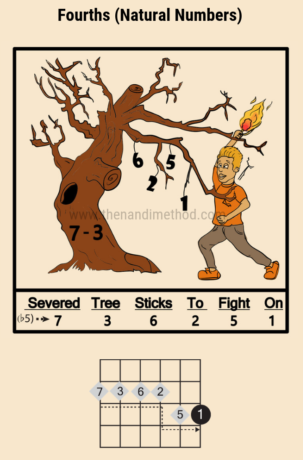
If you want to focus only on natural intervals (1, 2, 3, 4, 5, 6, 7) within the major scale, arrange them as 7-3-6-2-5-1-4 using this mnemonic:
Severed Tree Sticks To Fight On For.
Starting from the 7th—one fret below the root—the pattern continues smoothly across the fretboard, revealing how every note connects through the logic of fourths rather than memorized shapes.