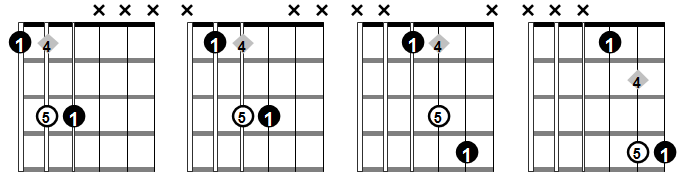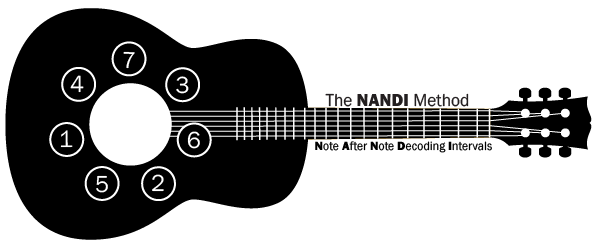
Suspended (Sus) chords replace the 3ʳᵈ with either a 2ⁿᵈ or a 4ᵗʰ, removing the major or minor quality and creating a more open sound.
Watch the companion video below to learn how to identify Sus2 chords in CAGED shapes using the NANDI Method.
Sus4 Chords
Formula: 1-4-5
Unlike major or minor triads, Sus4 chords contain no 3ʳᵈ.
Root Position: 1-4-5
1ˢᵗ Inversion: 4-5-1
2ⁿᵈ Inversion: 5-1-4
Example:
Csus4 = C-F-G
1ˢᵗ Inv = F-G-C
2ⁿᵈ Inv = G-C-F
Sus2 Chords
Formula: 1-2-5
Sus2 chords replace the 3ʳᵈ with the 2ⁿᵈ.
Root Position: 1-2-5
1ˢᵗ Inversion: 2-5-1
2ⁿᵈ Inversion: 5-1-2
Example:
Csus2 = C-D-G
1ˢᵗ Inv = D-G-C
2ⁿᵈ Inv = G-C-D
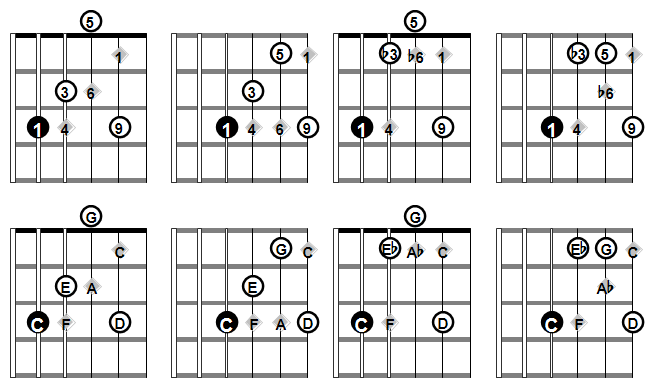
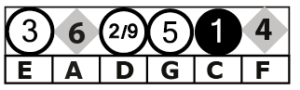
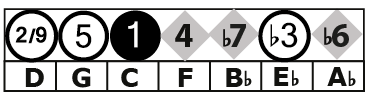
In the diagrams below, adjacent fourths (grey diamonds) act as reference points for locating each chord tone.
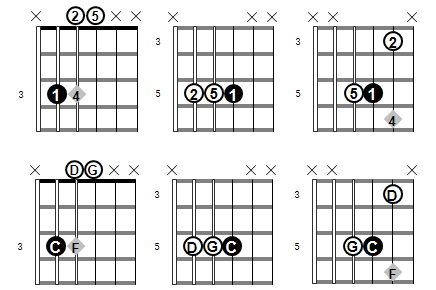
Practice these shapes using the Interval Chorder and the fourth-reference patterns shown below.
Watch the companion video below to learn how to visualize Csus2 chords across the entire fretboard.
Add Chords
Add chords are major or minor triads with one additional scale tone added. Unlike suspended chords, the 3ʳᵈ remains in the chord.
Common formulas:
• Add9 = 1-3-5-9
• m(add9) = 1-♭3-5-9
• Add11 = 1-3-5-11
• Add6 = 1-3-5-6
The added note colors the chord without changing its basic major or minor quality.
| Add Chords - Root C | ||||
|---|---|---|---|---|
| C | E | G | C Maj | |
| 1 | 3 | 5 | ||
| C | E | G | D | C (add9) |
| 1 | 3 | 5 | 9 | |
| C | E♭ | G | D | Cm (add9) |
| 1 | ♭3 | 5 | 9 | |
Power Chords
Formula: 1-5
Power chords contain only the root and perfect 5ᵗʰ, making them neither major nor minor.
Examples:
C5 = C-G
G5 = G-D
A5 = A-E
Because no 3ʳᵈ is present, the same shape works over both major and minor harmony. Power chords are widely used in rock, blues, punk and metal because they are simple, movable and produce a strong, clear sound.
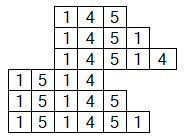
1 → 4 → 5 → 1