Every major scale has a relative minor that contains exactly the same notes and key signature. The only difference is the starting note (root).
To find the relative minor, count down three half-steps (or up a major 6ᵗʰ) from the major root.
Example:
C Major → A Minor
Major Scale Degrees:
1-2-3-4-5-6-7
Natural Minor Scale Degrees:
1-2-♭3-4-5-♭6-♭7
When arranged in fourths, both scales produce the same note sequence:
C Major:
B-E-A-D-G-C-F
A Minor:
B-E-A-D-G-C-F
The notes are identical because C Major and A Minor are relative keys. Only the interval numbers change.

The table above shows how the same notes receive different interval names. Notice that 6 in the major scale becomes 1 (the root) in its relative minor.
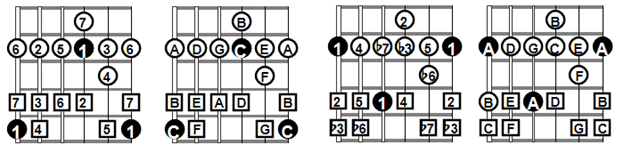

The diagrams below show the same fretboard notes for both scales. Although the note locations are identical, the interval labels differ because the tonal center changes from C to A.