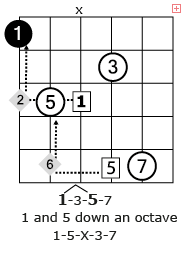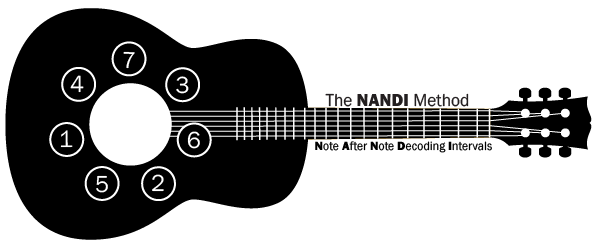
Seventh chords are formed by stacking another 3ʳᵈ above a triad. Since a 3ʳᵈ above the 5 is the 7ᵗʰ, each triad produces a corresponding seventh chord with its own sound and harmonic function.
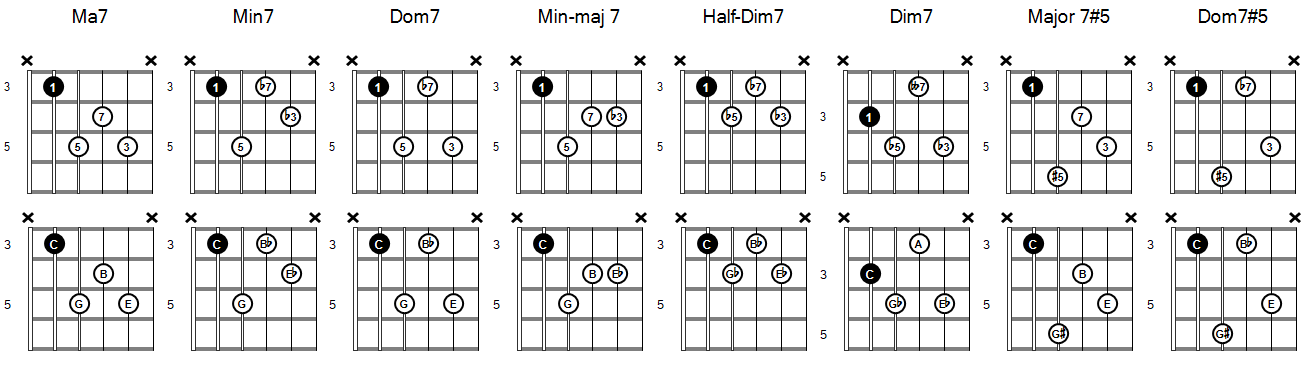
The diagrams below show the most common seventh chord qualities.
Seventh Chords
Quality Triad Intervals Root C
Major 7th Major (1-3-5) 1 - 3 - 5 - 7 C-E-G-B
Dominant 7th Major (1-3-5) 1 - 3 - 5 - ♭7 C-E-G-B♭
Minor 7th Minor (1-♭3-5) 1- ♭3 - 5 -♭7 C-E♭-G-B♭
Min-Maj 7th Minor (1-♭3-5) 1 - ♭3 - 5 - 7 C-E♭-G-B
Half-Dim 7th Diminished (1-♭3-♭5) 1 - ♭3 - ♭5 - ♭7 C-E♭-G♭-B♭
Dim 7th Diminished (1-♭3-♭5) 1-♭3-♭5-𝄫7 C-E♭-G♭-B𝄫
Maj 7th(#5) Augmented (1-3-#5) 1-3-#5-7 C-E-G#-B
Dominant 7th (#5) Augmented (1-3-#5) 1-3-#5-♭7 C-E-G#-B♭
Diminished Seventh
The diminished seventh chord is one of the few chords that uses a double-flat seventh (𝄫7).
A minor 3ʳᵈ above 5 produces ♭7.
A minor 3ʳᵈ above ♭5 produces ♭♭7.
Although ♭♭7 sounds the same as 6 (enharmonic), it is spelled ♭♭7 because the chord is constructed entirely by stacking 3ʳᵈs.
Major Seventh Drop 2 Voicing
Closed voicings keep all chord tones within one octave. Open (spread) voicings are created by dropping one or more voices down an octave.
Watch the companion video below to learn how to identify Major 7 Drop 2 chords using the NANDI Method.
Drop 2
Drop the 2ⁿᵈ highest note of a closed-position chord down one octave.
Closed:
5-7-1-3 (G-B-C-E)
Drop 2:
1-5-7-3 (C-G-B-E)
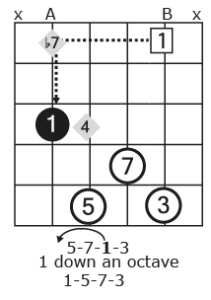
Drop 2 Chords in C major
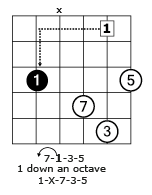
Major Seventh Drop 3 Voicing
Drop the 3ʳᵈ highest note of a closed-position chord down one octave.
Closed:
7-1-3-5 (B-C-E-G)
Drop 3:
1-x-7-3-5 (C-x-B-E-G)
Major Seventh Drop 2 & 4 Voicing
Drop the 2ⁿᵈ and 4ᵗʰ highest notes of a closed-position chord down one octave.
Closed:
1-3-5-7 (C-E-G-B)
Drop 2 & 4:
1-5-x-3-7 (C-G-x-E-B)