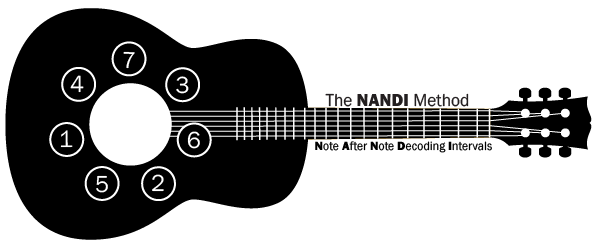
Pentatonic (“five-note”) scales are among the most widely used scales in rock, blues, country, pop, and jazz. The NANDI Method organizes these scales using the same fourth patterns used throughout this book, making them easier to visualize across the fretboard.
Major Pentatonic Scale
Formula:
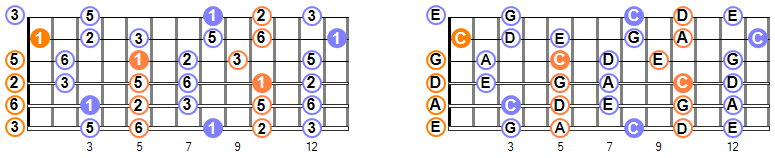
1-2-3-5-6
Fourth Order:
3-6-2-5-1
Watch the companion video below to learn how to visualize the major pentatonic scale using the Circle of Fourths.
The major pentatonic contains five notes and omits the 4ᵗʰ and 7ᵗʰ degrees of the major scale.
The diagrams below show the G Major Pentatonic using note names, interval numbers, and the E CAGED shape.


Follow the fourth order 3-6-2-5-1 across adjacent strings to visualize the entire scale instead of memorizing box patterns.
Minor Pentatonic Scale
Formula:
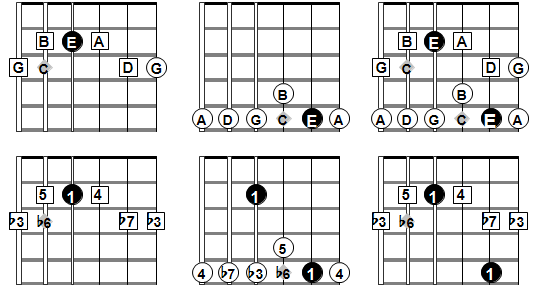
1-♭3-4-5-♭7
Fourth Order:
5-1-4-♭7-♭3
Watch the companion video below to learn how to visualize the minor pentatonic scale using the Circle of Fourths.
The minor pentatonic omits the 2ⁿᵈ and ♭6 degrees of the natural minor scale.

Relative Pentatonic Scales
Major and minor pentatonic scales share the same notes, just like relative major and minor scales.
Example:
G Major Pentatonic ↔ E Minor Pentatonic
Move down three frets (or up a major 6ᵗʰ) from the major root to find the relative minor.

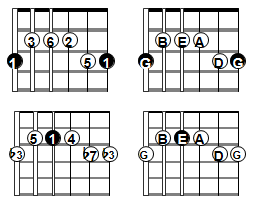
Notice that both scales contain the same notes but different interval numbers because the root changes.

To visualize the E Minor Pentatonic, begin with 5 (B) and follow the fourth order:
5-1-4-♭7-♭3
(B-E-A-D-G)
The diagrams below show the interval and note patterns across the fretboard.
Continue Your Training
For a complete workbook approach to visualizing major, natural minor, pentatonic, blues scales, modes, octave patterns, and CAGED relationships using the NANDI Method, see Guitar Scales Unleashed.
The companion Guitar Scales Unleashed mobile app is available on the App Store and Google Play, providing interactive exercises to reinforce every concept covered in the book.