Finding Octaves
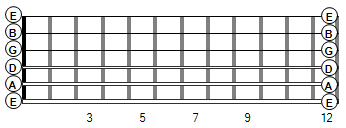
An octave is an interval of 12 half-steps (12 frets). It is the same note name as the root, played one octave higher.
Example:
• Open E → 12ᵗʰ fret E
• Open A → 12ᵗʰ fret A
Traditional Octave Shapes
The most common octave shapes are:
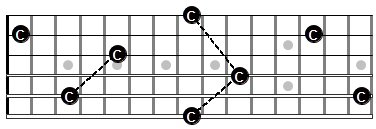
Two strings higher, two frets higher
• E → D
• A → G
Two strings higher, three frets higher
• D → B
• G → E
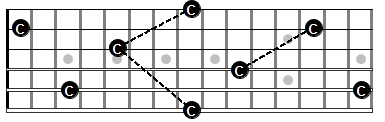
The NANDI Method expands these shapes by locating octaves on both higher and lower frets using the interval relationships between string pairs.
String Relationships
The open strings can be grouped according to the interval between notes on the same fret.
Major 2ⁿᵈ
• A → B
• D → E
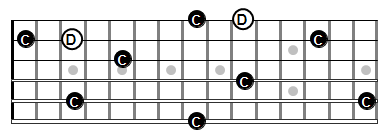
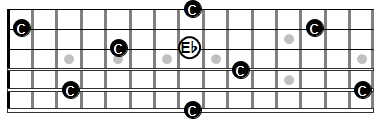
Minor 3ʳᵈ
• E → G
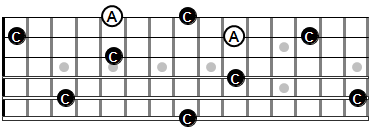
Major 6ᵗʰ
• D → B
• G → E
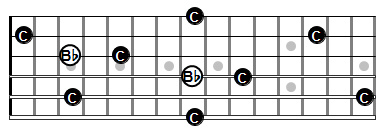
Minor 7ᵗʰ
• E → D
• A → G
These relationships remain the same everywhere on the fretboard.
Finding Octaves Using String Relationships
Instead of memorizing octave shapes, the NANDI Method uses the interval relationships between string pairs to locate octaves anywhere on the fretboard.
For each string pair, first identify the interval found on the same fret (2, ♭3, 6, or ♭7). Then make a simple fret adjustment to arrive at the octave (1).
The four string relationships are:
• Minor 7ᵗʰ (♭7 → 1)
• Minor 3ʳᵈ (♭3 → 1)
• Major 6ᵗʰ (6 → 1)
• Major 2ⁿᵈ (2 → 1)
This is the foundation for finding octaves on both higher and lower frets without relying on memorized octave shapes.
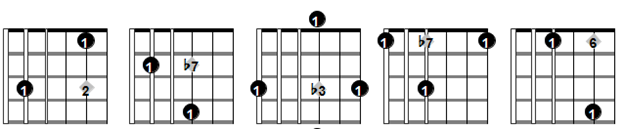
Major 2ⁿᵈ Relationship
The A–B and D–E string pairs are a major 2ⁿᵈ apart.
If the root (1) is on the lower string, the same fret on the upper string is 2.
Move down 2 frets from 2 to reach the octave (1).
Minor 7ᵗʰ Relationship
The E–D and A–G string pairs are a minor 7ᵗʰ apart.
If the root (1) is on the lower string, the note on the same fret is ♭7.
Move up 2 frets from ♭7 to reach the octave (1).
Minor 3ʳᵈ Relationship
The E–G strings are a minor 3ʳᵈ apart.
If the root (1) is on the E string, the same fret on the G string is ♭3.
Move down 3 frets from ♭3 to reach the octave (1).
Major 6ᵗʰ Relationship
The D–B and G–E string pairs are a major 6ᵗʰ apart.
If the root (1) is on the lower string, the same fret on the upper string is 6.
Move up 3 frets from 6 to reach the octave (1).
Summary
The NANDI Method locates octaves by using the interval already present between the strings.
• Minor 7ᵗʰ → ♭7 ↑ 2 frets = 1
• Minor 3ʳᵈ → ♭3 ↓ 3 frets = 1
• Major 6ᵗʰ → 6 ↑ 3 frets = 1
• Major 2ⁿᵈ → 2 ↓ 2 frets = 1
Once these four relationships are recognized, octaves can be located across the fretboard without relying on memorized octave shapes.