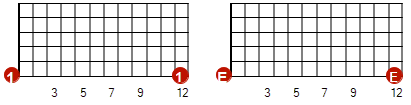
Single-String Intervals
Before learning intervals across the strings, it’s important to understand how they appear on a single string.
Watch the video below to learn how to use the Circle of Fourths to instantly identify intervals across all six strings using simple interval patterns instead of memorization.
An interval is the distance between two notes.
In the diagrams below, every interval is measured from the root E (1). Once you know the number of half-steps for each interval, you can identify any interval on the guitar.
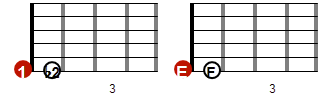
Half-Step (Minor 2ⁿᵈ)
The smallest interval in music is the half-step, equal to one fret.
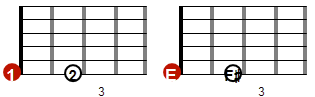
Whole-Step (Major 2ⁿᵈ)
A whole-step equals two half-steps, or two frets.
Thirds
A minor 3ʳᵈ is 3 half-steps.
Example: E–G
A major 3ʳᵈ is 4 half-steps.
Example: E–G♯

Fourths
A perfect 4ᵗʰ is 5 half-steps.
Example: E–A
An augmented 4ᵗʰ is 6 half-steps.
Example: E–A♯
It is simply a perfect 4ᵗʰ raised by one half-step.

Fifths
A perfect 5ᵗʰ is 7 half-steps.
Example: E–B
A diminished 5ᵗʰ is 6 half-steps.
Example: E–B♭
It is simply a perfect 5ᵗʰ lowered by one half-step.

Tritone
Notice that the augmented 4ᵗʰ (A♯) and diminished 5ᵗʰ (B♭) are both 6 half-steps from the root. Although they have different names, they sound the same and are collectively known as the tritone.
Sixths
A minor 6ᵗʰ is 8 half-steps.
Example: E–C
A major 6ᵗʰ is 9 half-steps.
Example: E–C♯

Sevenths
A minor 7ᵗʰ is 10 half-steps.
Example: E–D
A major 7ᵗʰ is 11 half-steps.
Example: E–D♯

Octave
An octave is 12 half-steps.
Example: E–E
Although the pitch is higher, it is the same note name as the root.