Primary & Secondary Dominants
Dominant chords resolve strongly a perfect 5ᵗʰ down (or a 4ᵗʰ up) to their target chord.
Primary Dominant
The primary dominant is the only dominant seventh chord that occurs naturally in a major key.
Example (C Major):
G7 → C
Secondary Dominants
A secondary dominant is a dominant seventh chord that temporarily tonicizes a diatonic chord other than the tonic. Because these chords are built outside the key, they contain one or more non-diatonic notes.
Examples in C Major:
A7 = A-C♯-E-G
E7 = E-G♯-B-D
The notes C♯ and G♯ are not found in C major, making these borrowed dominant chords.
Secondary dominants are written as V/X, where X is the chord they resolve to.
Examples:
A7 → Dm = V/ii
E7 → Am = V/vi
They are commonly used to create tension and lead smoothly into their target chords.
Watch the companion video below to learn how to identify Secondary Dominants using the NANDI Method.
Secondary Dominants in C Major
Using the order of fourths, each diatonic chord (except vii°) has a dominant located one fourth below.
V/iii = B7
V/vi = E7
V/ii = A7
V/V = D7
V/IV = C7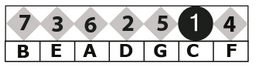
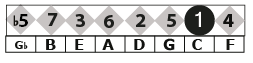
There is no secondary dominant for vii°, because its dominant root (G♭) is not diatonic to C major.
Watch the companion video below to learn how to identify all 12 dominant seventh chords from the key of C.