Perfect Fourth/Perfect Fifth Inversion
A perfect 4ᵗʰ and a perfect 5ᵗʰ are inversions of each other. If you move up a perfect 5ᵗʰ, you return by moving down a perfect 4ᵗʰ, and vice versa.
Example: C → G = Perfect 5ᵗʰ • G → C = Perfect 4ᵗʰ
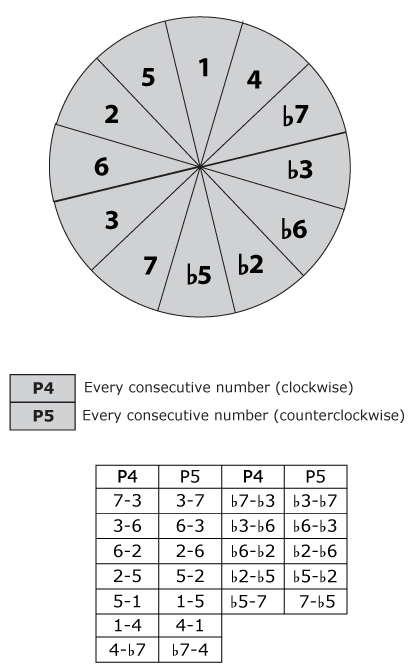
The Interval Wheel makes this relationship easy to visualize. Moving clockwise follows fourths, while moving counterclockwise follows fifths. One step in one direction is always the inversion of one step in the other.
On the fretboard, the same relationship appears naturally. Reading left to right follows perfect 4ᵗʰs, while reading the same pattern in reverse follows perfect 5ᵗʰs.
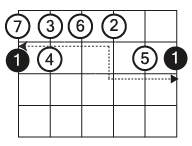
Fourth Pattern (left → right): 7–3–6–2–5–1–4
Fifth Pattern (right → left): 4–1–5–2–6–3–7

Notice that both patterns contain the same interval numbers—the only difference is the direction in which they are read. This inverse relationship is used throughout the NANDI Method to identify notes and intervals without memorization.