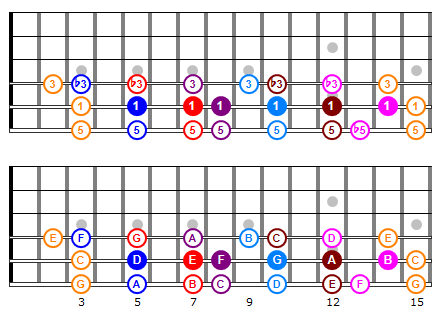
Voice leading is the art of connecting chords with the smallest possible movement between voices. Common tones are kept in the same voice (often the same string on the guitar), while the remaining notes move by the shortest distance.
The root movement between chords determines how many common tones they share:
Root movement of 2nd and 7th there are no common notes
Root movement of 4th and 5th there is 1 common note
Root movement of 3rd and 6th there are 2 common notes
Example: V-I
G Major → C Major
G-B-D
C-E-G
Placing G major in first inversion produces smoother voice leading:
B-D-G
C-E-G
Voice movement:
B → C (½ step)
D → E (Whole step)
G → G (Common tone)
Only two voices move while one remains unchanged.
First Inversion Voice Leading
When all diatonic triads are played in 1ˢᵗ inversion (3-5-1), the bass moves by only one or two frets throughout the entire major scale.
C Dm Em F G Am Bdim
E - G - C F - A - D G - B - E A - C - F B - D - G C - E - A D - F - B
3 - 5 - 1 ♭3 - 5 - 1 ♭3 - 5 - 1 3 - 5 - 1 3 - 5 - 1 ♭3 - 5 - 1 ♭3 - ♭5 - 1
One fret up from E is F Two frets up from F is G Two frets up from G is A Two frets up from A is B One fret up from B is C Two frets up from C is D Two frets up from D brings you back to E
Notice the bass movement:
E → F → G → A → B → C → D → E
Every movement is either 1 or 2 frets.
Second Inversion Voice Leading
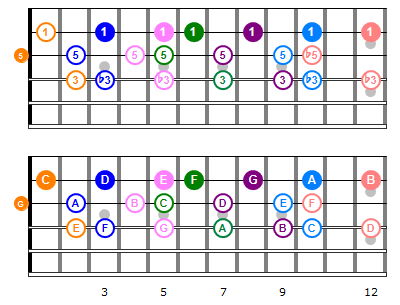
The same principle applies to 2ⁿᵈ inversions (5-1-3).
C Dm Em F G Am Bdim
G - C - E A - D - F B - E - G C - F - A D - G - B E - A - C F - B - D
5 - 1 - 3 5 - 1 - ♭3 5 - 1 - ♭3 5 - 1 - 3 5 - 1 - 3 5 - 1` - ♭3 ♭5 - 1 - ♭3
Two frets up from G is A Two frets up from A is B One fret up from B is C Two frets up from C is D Two frets up from D is E One fret up from E is F Two frets up from F brings you back to G
Bass movement:
G → A → B → C → D → E → F → G
Again, every movement is only 1 or 2 frets.