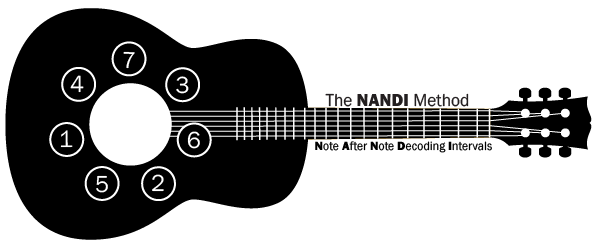
Before learning barre chords, become familiar with the five open CAGED chord shapes.
Watch the companion videos below to learn how to locate major and minor CAGED chords across the fretboard using the NANDI Method.
Major Barre Chords
Major barre chords are formed by moving an open E or A shape and using the index finger as a movable capo.
E Shape: 1-5-1-3-5-1
A Shape: 1-5-1-3-5
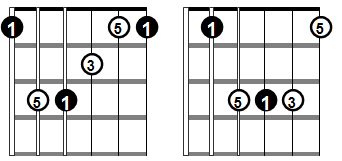
The NANDI Method uses fourths as reference points to locate the chord tones.
• Fourth above 1 = 4 → one fret lower = 3
• Fourth above 3 = 6 → two frets lower = 5
Pattern:
1 → 4 ↓1 = 3 → 6 ↓2 = 5
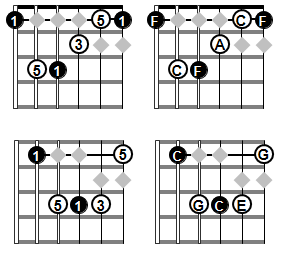

The most common movable major chords are:
E Shape → F Major
A Shape → C Major
Simply move the open shape to the desired fret and use the index finger as the barre.
Minor Barre Chords
Minor barre chords are created by moving the open Em and Am shapes.
E Shape: 1-5-1-♭3-5-1
A Shape: 1-5-1-♭3-5
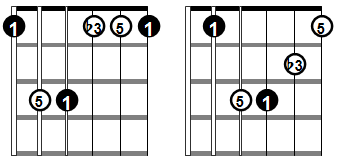
Using fourths:
• Fourth above 1 = 4 → two frets lower = ♭3
• Fourth above ♭3 = ♭6 → one fret lower = 5
Pattern:
1 → 4 ↓2 = ♭3 → ♭6 ↓1 = 5
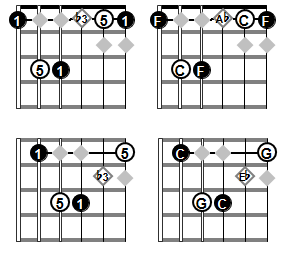
The most common movable minor chords are:
Em Shape → Fm
Am Shape → Cm
Dominant 7 Barre Chords
Dominant 7th chords are simple modifications of the major barre shapes.
E Shape: 1-5-♭7-3-5-1
A Shape: 1-5-♭7-3-5
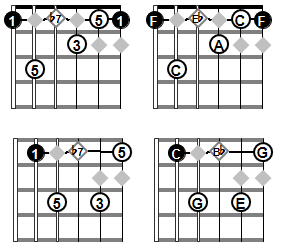
Create them by lowering one root (octave) to ♭7.
E Shape: Remove the pinky so the barre frets the D string.
A Shape: Remove the ring finger so the barre frets the G string.
This single alteration converts the major barre chord into a dominant seventh while preserving the rest of the shape.