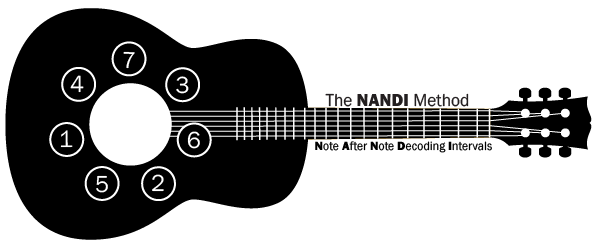
Watch the companion video below to learn three ways to recall the notes of the Melodic Minor scale.
Natural Minor
1-2-♭3-4-5-♭6-♭7
| 1 | ♭2 | 2 | ♭3 | 3 | 4 | ♭5 | 5 | ♭6 | 6 | ♭7 | 7 | 1 |
|---|---|---|---|---|---|---|---|---|---|---|---|---|
| C | D | E♭ | F | G | A♭ | B♭ | C |
The Melodic Minor scale is derived by raising both the ♭6 and ♭7 of the Natural Minor scale.
Melodic Minor
1-2-♭3-4-5-6-7
Example: C Melodic Minor
C-D-E♭-F-G-A-B
| 1 | ♭2 | 2 | ♭3 | 3 | 4 | ♭5 | 5 | ♭6 | 6 | ♭7 | 7 | 1 |
|---|---|---|---|---|---|---|---|---|---|---|---|---|
| C | D | E♭ | F | G | A | B | C |
Fourth Pattern
Order of fourths:
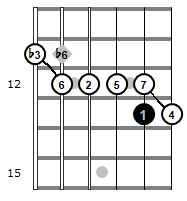
♭3-6-2-5-1-4-7
Pattern:
Aug4 → P4 → P4 → P4 → P4 → Aug4
Across the fretboard:
• ♭3 → 6 = Augmented 4ᵗʰ (up one string, up one fret)
• 6 → 2 → 5 → 1 → 4 = Perfect 4ᵗʰs
• 4 → 7 = Augmented 4ᵗʰ (up one string, up one fret)
| Melodic Minor Modes |
|||||||
|---|---|---|---|---|---|---|---|
aug4 | P4 | P4 | P4 | P4 | aug4 | ||
| ♭3 | 6 | 2 | 5 | 1 | 4 | 7 | Melodic Minor |
Chords and modes in C melodic minor :
Melodic Minor Modes
| Modes | Chord Types | Chord Intervals | Seventh Chords |
|---|---|---|---|
| C Melodic Minor | CmMaj7 | 1-♭3-5-7 | C-E♭-G-B |
| D Dorian♭2 | Dmin7 | 1-♭3-5-♭7 | D-F-A-C |
| E♭ Lydian Augmented | E♭Maj7(#5) | 1-3-#5-7 | E♭-G-B-D |
| F Lydian Dominant | F7 | 1-3-5-♭7 | F-A-C-E♭ |
| G Mixolydian♭13 | G7 | 1-3-5-♭7 | G-B-D-F |
| A Aeolian♭5 | Amin7(♭5) | 1-♭3-♭5-♭7 | A-C-E♭-G |
| B Altered Scale | B7alt | 1-3-♭5-♭7 | B-D#-F-A |
Illustrated below are seventh chords belonging to the melodic minor mode as drop 2 voicings (root-fifth-seventh-third).
Min maj7 Min7 Maj7#5 Dom7 Dom7 Min7♭5 Min7♭5

Melodic Minor Modes & Chord Scales
Like the major scale, melodic minor has a total of seven modes.
1st Mode: C Melodic Minor (1-2-♭3-4-5-6-7)
The root chord is a Minor-major Seventh (1-♭3-5-7). Build a minor triad (2-4-6) a major second above the root (9-11-13). The chord scale is 1-♭3-5-7-9-11-13. From C, this would be C-E♭-G-B-D-F-A.
2nd Mode: D Dorian♭2 (1-♭2-♭3-4-5-6-♭7)
The root chord is a Minor Seventh (1-♭3-5-♭7). Build an augmented triad (♭2-4-6) a minor second above the root (♭9-11-13). The chord scale is 1-♭3-5-♭7-♭9-11-13. From D, this would be D-F-A-C-E♭-G-B.
3rd Mode: E♭ Lydian#5 (1-2-3-#4-#5-6-7)
The root chord is a major seventh with a raised fifth. Build a major triad (2-#4-6) one major second above the root (9-#11-13). The chord scale is 1-3-#5-7-9-#11-13. From E♭, this would be E♭-G-B-D-F-A-C.
4th Mode: F Lydian Dominant (1-2-3-#4-5-6-♭7)
The root chord is a dominant seventh. Build a major triad (2-#4-6) a major second above the root (9-#11-13). The chord scale is 1-3-5-♭7-9-#11-13. From F this would be F-A-C-E♭-G-B-D.
5th Mode: G Mixolydian♭13 (1-2-3-4-5-♭6-♭7)
The root chord is a dominant seventh. Build a diminished triad a major second (2-4-♭6) above the root (9-11-♭13). The chord scale is 1-3-5-♭7-9-11-♭13. From G, this would be G-B-D-F-A-C-E♭.
6th Mode: A Aeolian♭5 (1-2-♭3-4-♭5-♭6-♭7)
The root chord is a half-diminished seventh chord. Build a diminished triad (2-4-♭6) a major second above the root (9-11-♭13). The chord scale is 1-♭3-♭5-♭7-9-11-♭13. From A, this would be A-C-E♭-G-B-D-F.
7th Mode: B Altered Scale (Super Locrian) (1-♭2-♭3-♭4-♭5-♭6-♭7)
The ♭4 on the scale can be seen as the major 3rd of the chord, and as a result, the chord would be an altered dominant (1, 3, ♭5, ♭7) instead of a m7(♭5) chord. The ♭3 would change from a chord tone to a tension (#9) and the whole altered scale would be:1, ♭9, #9, 3, ♭5, ♭13, ♭7. Build a minor triad (♭2-♭4-♭6) a minor second above the root (♭9-♭11-♭13) where ♭11 is the enharmonic equivalent of 3. The chord scale is 1-♭3-♭5-♭7-♭9-♭11-♭13. From B, this would be B-D#-F-A-C-E♭-G.