Understanding guitar tuning and the musical alphabet is the foundation of guitar theory. In the NANDI method, the open strings become your reference points for identifying notes, intervals, scales, and chords across the fretboard using the Circle of Fourths/Fifths and interval relationships rather than memorizing individual fret locations.
Standard Guitar Tuning
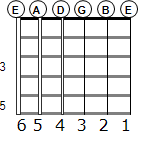
Almost all acoustic and electric guitars have six strings. They are numbered from 6–1, with the lowest (thickest) string being 6 and the highest (thinnest) string being 1.
• 6 = E
• 5 = A
• 4 = D
• 3 = G
• 2 = B
• 1 = E
These six notes are called open strings because they are played without pressing a fret.
Open String Facts
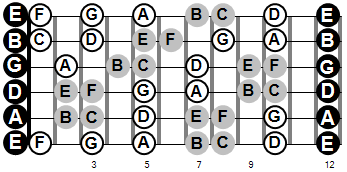
• The open-string notes (E-A-D-G-B-E) repeat at the 12ᵗʰ fret one octave higher.
• Each fret equals one half-step (semitone).
• The only natural half-steps are:
E–F
B–C
• All other natural notes are separated by two frets (a whole-step).
The Music Alphabet
Music uses only seven natural notes:
C D E F G A B
After B, the sequence repeats:
C D E F G A B C
Naturals, Sharps, and Flats
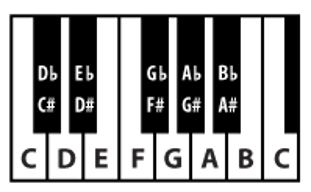
Besides the seven natural notes, music also contains five sharp notes (♯) and five flat notes (♭).
Sharp Notes
F♯ C♯ G♯ D♯ A♯
Flat Notes
B♭ E♭ A♭ D♭ G♭
The natural notes are the white keys on a piano, while the sharps and flats are the black keys.
Enharmonic Notes
Some notes have two different names but sound exactly the same.
Examples:
• C♯ = D♭
• D♯ = E♭
• F♯ = G♭
• G♯ = A♭
• A♯ = B♭
These are called enharmonic notes.
The 12 Notes in Music
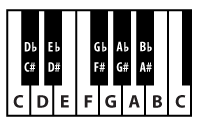
There are 12 notes in music. After the 12ᵗʰ note, the sequence repeats.
Starting from C:
C – C♯/D♭- D- D♯/E♭- E- F- F♯/G♭- G- G♯/A♭- A- A♯/B♭- B
Starting from A:
A – A♯/B♭- B- C – C♯/D♭- D- D♯/E♭- E- F- F♯/G♭- G- G♯/A♭
Half-Step Pattern
There is a sharp or flat between every pair of natural notes except:
• B–C
• E–F
These note pairs are already one half-step apart, so there is no black key between them on a piano.
There is a sharp or flat between all the natural notes except for B-C and E-F. Those are the pairs of notes on a keyboard that have no black key in between.
Sharp (♯)
A sharp raises a note by one half-step (one fret).
Example:
F → F♯
F♯ is the fret (or black key) between F and G.
Flat (♭)
A flat lowers a note by one half-step (one fret).
Example:
D → D♭
D♭ is the fret (or black key) between C and D.
Enharmonic Notes
You may wonder, “What’s the difference between C♯ and D♭?” They sound exactly the same but have different names. These are called enharmonic notes, and you’ll learn why both names are used later.
Examples:
• C♯ = D♭
• D♯ = E♭
• F♯ = G♭
• G♯ = A♭
• A♯ = B♭
Practice with the Fretboard Notes App
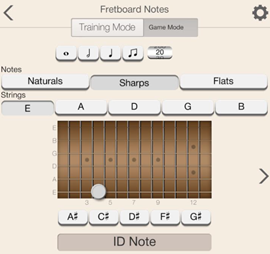
The Fretboard Notes app from the Guitar Intervals Unleashed series helps reinforce note recognition through interactive practice.
Features:
• Practice natural notes, sharps, flats, or any combination.
• Focus on a single string (E, A, D, G, or B).
• Training Mode with an optional metronome.
• Game Mode with both a metronome and timer to challenge your speed and accuracy.
• Available on Google Play and the App Store.
Intervals and Qualities
An interval is the distance between two notes. There are 12 intervals, matching the 12 notes in music. Intervals are the building blocks of:
- Harmony – notes played at the same time.
- Melody – notes played one after another.
Every interval has two characteristics:
- Number – how far apart the notes are.
- Quality – the type of interval.
| Interval Name | Interval Quality | Interval Number | Half-step Distance | Interval Notes |
|---|---|---|---|---|
| Unison (P1) | Perfect | 1 | 0 | C |
| Minor Second (min2) | Minor | ♭2 | 1 | C to D♭ |
| Major Second (maj2) | Major | 2 | 2 | C to D |
| Minor Third (min3) | Minor | ♭3 | 3 | C to E♭ |
| Major Third (min3) | Major | 3 | 4 | C to E |
| Perfect Fourth (P4) | Perfect | 4 | 5 | C to F |
| Diminished Fifth (dim5) - Tritone | Diminished | ♭5 | 6 | C to G♭ |
| Perfect Fifth (P5) | Perfect | 5 | 7 | C to G |
| Minor Sixth (min6) | Minor | ♭6 | 8 | C to A♭ |
| Major Sixth (maj6) | Major | 6 | 9 | C to A |
| Minor Seventh (min7) | Minor | ♭7 | 10 | C to B♭ |
| Major Seventh (maj7) | Major | 7 | 11 | C to B |
| Octave (P8) | Perfect | 8 (1) | 12 | C to C |
Interval Numbers
There are eight interval numbers:
• Unison (1) – C to C
• Second (2) – C to D
• Third (3) – C to E
• Fourth (4) – C to F
• Fifth (5) – C to G
• Sixth (6) – C to A
• Seventh (7) – C to B
• Octave (8) – C to C (12 half-steps higher)
Interval Qualities
There are five interval qualities:
• Perfect (P)
• Major (Maj)
• Minor (Min)
• Augmented (Aug)
• Diminished (Dim)
Perfect Intervals
The four perfect intervals are:
• Perfect Unison (P1) – C to C
• Perfect Fourth (P4) – C to F
• Perfect Fifth (P5) – C to G
• Perfect Octave (P8) – C to C (12 half-steps higher)
Raising a perfect interval by one half-step makes it augmented. Lowering it by one half-step makes it diminished.
Examples:
• C–G = Perfect 5ᵗʰ (P5)
• C–G♯ = Augmented 5ᵗʰ (Aug5)
• C–G♭ = Diminished 5ᵗʰ (Dim5)
Tritone
A Diminished 5ᵗʰ (Dim5) is also called a tritone.
Example:
• C–G♭ = Tritone
Major and Minor Intervals
The 2ⁿᵈ, 3ʳᵈ, 6ᵗʰ, and 7ᵗʰ can be either major or minor.
Use the C major scale (the white keys on a piano) as your reference. These intervals are naturally major. Lowering them by one half-step makes them minor.
Examples:
• C–D = Major 2ⁿᵈ (Maj2) C–D♭ = Minor 2ⁿᵈ (Min2)
• C–E = Major 3ʳᵈ (Maj3) C–E♭ = Minor 3ʳᵈ (Min3)
• C–A = Major 6ᵗʰ (Maj6) C–A♭ = Minor 6ᵗʰ (Min6)
• C–B = Major 7ᵗʰ (Maj7) C–B♭ = Minor 7ᵗʰ (Min7)
Chromatic Scale
The chromatic scale contains all 12 notes in music. Each note is one half-step (one fret) from the next, so there are no skipped notes.
Example: C Chromatic Scale
C – C♯/D♭ – D – D♯/E♭ – E – F – F♯/G♭ – G – G♯/A♭ – A – A♯/B♭ – B – C
Scale Degrees
In every scale, the starting note is called the root (1). Each note is assigned a scale degree relative to the root.
Example: C Chromatic Scale

A Useful Pattern
Notice that intervals with the same number always share the same music letter. The only difference is whether the note is natural, sharp, or flat.
In the key of C:
• ♭2 and 2 = D♭ and D
• ♭3 and 3 = E♭ and E
• ♭5 and 5 = G♭ and G
• ♭6 and 6 = A♭ and A
• ♭7 and 7 = B♭ and B
Both intervals use the same letter name (D, E, G, A, or B). The flat interval is simply one half-step lower than the major (or perfect) interval.
Because the key of C contains only natural notes, the flat scale degrees correspond to the black keys on a piano, making this relationship easy to visualize. This won’t always be the case in other keys, but C provides the clearest reference for learning interval names and scale degrees.
The 1 (root) and 4 do not have flat equivalents in the chromatic scale.
Chromatic Scale on Guitar
On the guitar, the chromatic scale is played by moving one fret at a time because every note is one half-step apart.
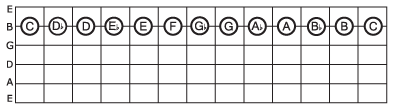
Every fret is played without skipping.
The same pattern applies to every string. For example:
• Open E → 12ᵗʰ fret E = E chromatic scale
• Open A → 12ᵗʰ fret A = A chromatic scale
• Open D → 12ᵗʰ fret D = D chromatic scale
Regardless of the starting note, the chromatic scale always contains 12 notes, each separated by one half-step (one fret).